
Code of Conduct


Goal and Performance Highlights
Performance 2025




Commitment, Challenge and Opportunity
The Company is committed to operating with transparency and fairness under the principles of good corporate governance, in compliance with all applicable laws and regulations. At the same time, the Company is dedicated to developing innovative and distinctive residential project designs that ensure the highest levels of customer satisfaction. The Company also places strong emphasis on efficient value chain management and effective economic risk management to support stable and sustainable business growth.
Nevertheless, maintaining governance and transparency standards amid intense competition, evolving laws and regulations, and heightened stakeholder expectations presents significant challenges. In addition, managing economic risks in uncertain conditions and developing innovations that meet rapidly changing customer demands remain key factors that the Company must continuously address and adapt to.
Operating with transparency and a firm commitment to good governance strengthens stakeholder confidence. At the same time, delivering innovative, high-quality projects creates differentiation and competitive advantage. Furthermore, effective value chain management and prudent economic risk management provide opportunities for business expansion and reinforce the Company’s long-term sustainability.
Management and Operational Approach
The Company has established sustainability policies and practices in the areas of economic performance and corporate governance as follows:
- Operate under the principles of good corporate governance, focusing on conducting business in accordance with relevant laws and regulations to ensure transparency, credibility, and fairness for all stakeholders.
- Focus on innovation to deliver residential projects with unique design and superior quality, exceeding customer expectations and creating pride among Noble residents.
- Prioritize efficient value chain management while upholding fairness and transparency in dealing with business partners.
- Manage economic risks and crises across all business processes to minimize losses from unmet targets while maximizing opportunities to support business growth and transformation.
In addition, the Company attaches importance to supervising operations to ensure compliance with relevant laws, rules, requirements, and procedures related to its business operations, which is an important mechanism that helps all processes and work steps of the Company to be accurate and thorough and encourage the Company to operate its business smoothly and sustainably. Therefore, the Company has appointed a Compliance Unit to oversee operations. The unit is responsible for supervising work covering four main areas as follows:
- To supervise legal affairs related to business operations.
- To supervise the performance of employees and executives.
- To supervise the implementation of procurement regulations.
- To supervise compliance with the rules and regulations of the Stock Exchange of Thailand (SET), the Securities and Exchange Commission (SEC) and other related aspects.
Corporate Governance Structure
The Company has established a governance structure by appointing a Board of Directors composed of individuals with leadership qualities, knowledge, abilities, and extensive business experience. Each director is aware of the responsibilities entrusted to them by the shareholders to represent and establish policies, vision, mission, strategies, objectives, business plans, and budgets of the Company. They oversee the management to ensure efficient and effective operations within the framework of relevant laws, regulations, company objectives, and shareholder resolutions. Additionally, the sub-committees have been formed to assist in monitoring and overseeing the Company’s operations, reporting regularly to the Board of Directors.
Organizational Structure
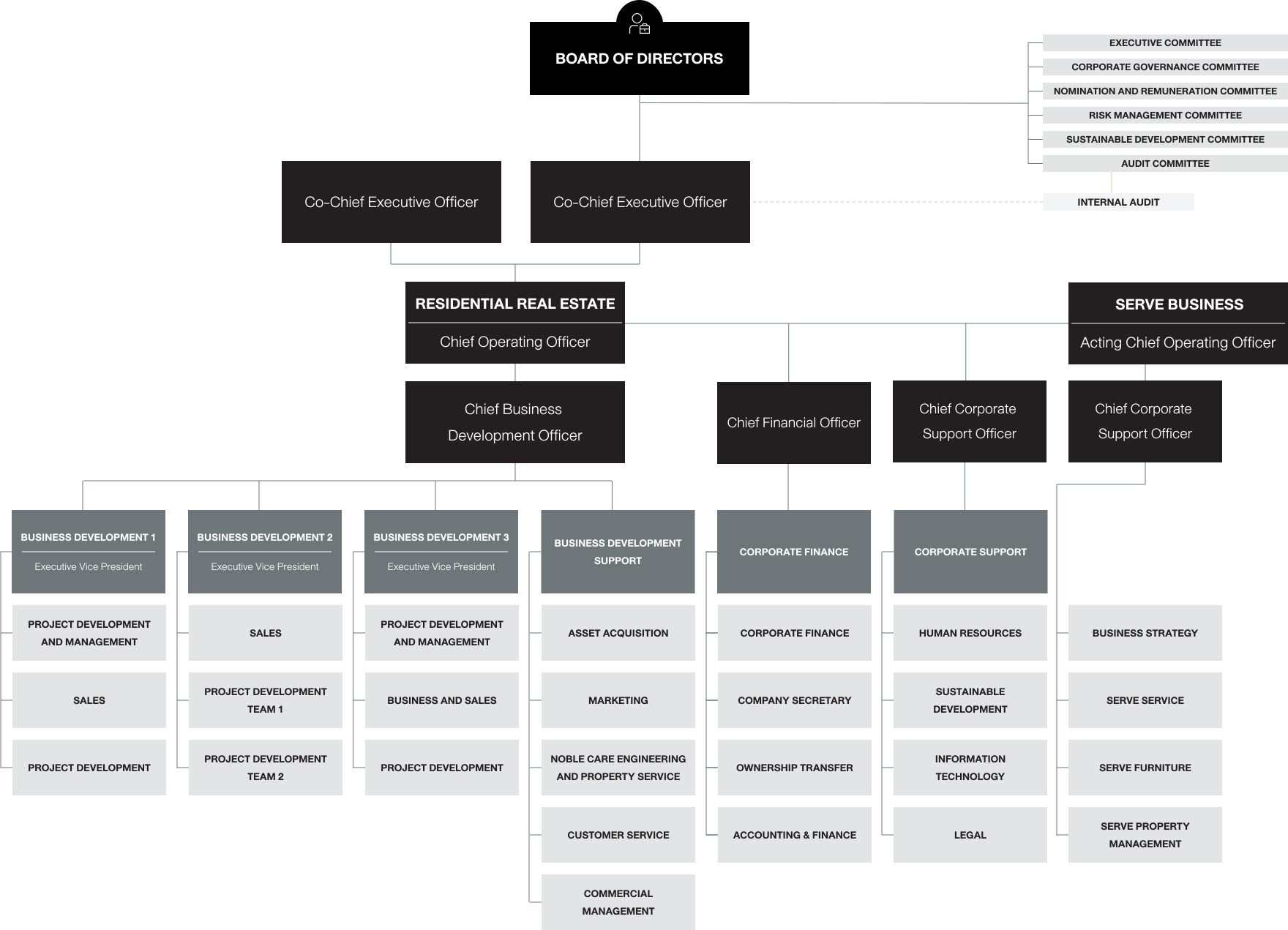
Components of the Company’s Board of Directors
According to the Company’s Articles of Association, the Board of Directors must consist of no fewer than five members, with at least half of the total number residing in the Kingdom of Thailand and possessing the qualifications as prescribed by law. As of December 31, 2025, the Company had a total of 11 directors.


Furthermore, the Company has established a diversity policy within the board structure (Board Diversity), comprising board members with diverse qualifications, experience, knowledge, skills, and expertise. This is assessed using a Board Skill Matrix to align with the Company’s business strategies, without limiting based on gender, race, religion, while promoting inclusivity and independence from management influence.
Board Skill Matrix
| Board of Directors | Board Skill Matrix | |||||||||
|---|---|---|---|---|---|---|---|---|---|---|
| Real Estate Development and Related Business</span > | Law | Strategic Planning | Accounting & Finance | Marketing & PR | Risk Management | HR Management & Organization Development</span > | Corporate Governance | International Business | Sustainable Development | |
| 1. Ms. Punnee Chaiyakul | • | • | • | • | • | • | ||||
| 2. Mr. Thongchai Busrapan | • | • | • | • | • | • | • | • | • | • |
| 3. Mr. Frank Fung Kuen Leung | • | • | • | • | • | |||||
| 4. Mr. Shuo Ting Wu | • | • | • | • | • | |||||
| 5. Mr. William Wayne Lau | • | • | • | • | ||||||
| 6. Assoc.Prof. Natchanont Komuttipong, Ph.D. | • | • | • | • | • | • | ||||
| 7. Torboon Puangmala, Ph.D. | • | • | • | • | • | • | • | • | ||
| 8. Mr. Voraphot Chanyakomol | • | • | • | • | • | • | • | |||
| 9. Mr. Wittaya Luengsukcharoen | • | • | • | • | • | • | ||||
| 10. Mr. Sira Udol | • | • | • | • | • | • | • | |||
| 11. Ms. Thippawan Karoonsatitchai | • | • | • | • | • | • | ||||
| Total | 11 | 4 | 11 | 6 | 5 | 8 | 7 | 11 | 3 | 4 |
Anti-Corruption
The Company is committed to conducting business with honesty, integrity, ethics, and transparency, and is not involved in all forms of corruption. Executives and employees of the Company are not allowed to commit acts of corruption and bribery for business benefits to prevent corruption risks. In addition, the Board of Directors has approved the Anti-Corruption Policy and guidelines and has announced their enforcement in accordance with the guidelines of the Thai Private Sector Collective Action Coalition Against Corruption to demonstrate the Company’s intention to completely combat all forms of corruption through the Company’s website www.noblehome.com. The Company’s directors, executives and employees are prohibited from participating in any form of corruption, both directly and indirectly, and must comply with all applicable laws related to anti-corruption, as well as support and encourage personnel at all levels to see the importance and have an anti-corruption mindset, including encouraging employees to attend external trainings organized by various agencies, both public and private, to promote honesty and responsibility in performing their duties. In addition, the Company has established a central unit responsible for monitoring and assessing, as well as punishing, violations or non-compliance with such policies and guidelines.
The Company regularly assesses risks related to corruption(at least once a year) GRI 205-1 and establishes guidelines on the internal control system for various aspects of operations to supervise operations and prevent potential risks from corruption. The Company has assigned to the Risk Management Committee the duties and responsibilities to oversee the assessment of risks related to corruption of the Company. The Internal Audit Group is responsible for the process of auditing, monitoring, and assessing the performance of internal control and report the results to the Risk Management Committee.
Complaint and Whistleblowing Channels
The Company establishes policies and guidelines regarding reporting misconduct and providing protection for whistleblowers to provide opportunities for both internal and external stakeholders to report misconduct or complaints related to ethical and business conduct violations, internal control deficiencies, legal non-compliance, or company regulations, including corruption, to facilitate improvements in management for better efficiency and effectiveness. For complaints received through various channels, the Company will investigate and determine appropriate corrective actions and develop more efficient work processes to prevent future violations.
- Receipt and Verification: The recipient of the complaint verifies and forwards it to the coordinator. In cases where the complained party is a department, the department conducts an internal review and informs the audit committee to appoint an internal complaint coordinator within 3 business days from the date of receiving the complaint.
- Evidence Collection and Evaluation: The coordinator collects and evaluates evidence, sending a report to the internal auditor within 7 business days of receiving the complaint.
- Internal Audit: The internal auditor conducts an audit and summarizes the findings within 7 business days of receiving the report from the coordinator.
- Conclusion: The authorized person renders a decision within 3 business days of receiving the report from the auditor.
- Result Notification: The internal auditor notifies the coordinator of the decision.
- Result Reporting: The coordinator reports the decision to the complainant, the recipient, the complained party, the cooperating auditor, or other necessary parties. The audit committee directly reports the facts to the Company’s board for their consideration and to act regarding compliance policies and issues affecting senior management.
The Company has established policies and guidelines for reporting clues of wrongdoing, protecting informants and publishing the information on the Company’s website www.noblehome.com, in addition to providing channels for all stakeholder groups to report or file complaints about activities that are in violation of laws, corporate governance principles, the Code of Conduct and issues related to corruption as follows:
- Website : www.noblehome.com
- Email : cg@noblehome.com
- Complaint Center : Chairman of the Audit Committee Noble Development Public Company Limited (Head Office) 1035 Noble Building, Ploenchit Road, Lumpini Sub-district, Pathumwan District, Bangkok 10330
- Tel : +66 2251-9955 ext. 1500
The Company provides protection and measures for damages. The Company shall keep the information of the whistleblower or the complainant confidential, and will only disclose necessary information, considering the safety and damage of the person reporting the source of information or related persons, as well as providing contact information to all groups of stakeholders who report or filed a complaint in such cases. The Company provides a central agency responsible for monitoring and evaluating, as well as punishing, violations or non-compliance with policies and guidelines. The agency also serves as a center for receiving information on matters that may cause damage to the Company, before submitting the information to the Company’s Audit Committee for further acknowledgement. After receiving such complaints, the Company’s Board and executives will consider and investigate the facts of the complaint and take appropriate corrective action and will periodically follow up on the progress of the complaint.
- In cases where the Company receives reports of ethical misconduct, corruption, or wrongdoing by directors, executives, or employees, the Audit Committee will conduct an appropriate investigation to ascertain the facts. This process will adhere to the Company’s policies, bylaws, and relevant laws. Disciplinary actions, which may include termination, will be taken in accordance with these regulations. Legal penalties may also apply if the misconduct is proven to violate the law.
- In case that representatives, intermediaries, distributors, service providers, or contractors of the Company violate the anti-corruption criteria or become aware of actions that contravene the anti-corruption policy but fail to report them to the Company through the designated channels, or provide false information when questioned by the Company’s investigating officers about actions that may violate this policy, the Company reserves the right to terminate the contract.
Stakeholders Directly Impacted

Executives & Employees

Customers

Community & Society

Government Agencies

Investors & Shareholders

Suppliers & Contractors

Creditors