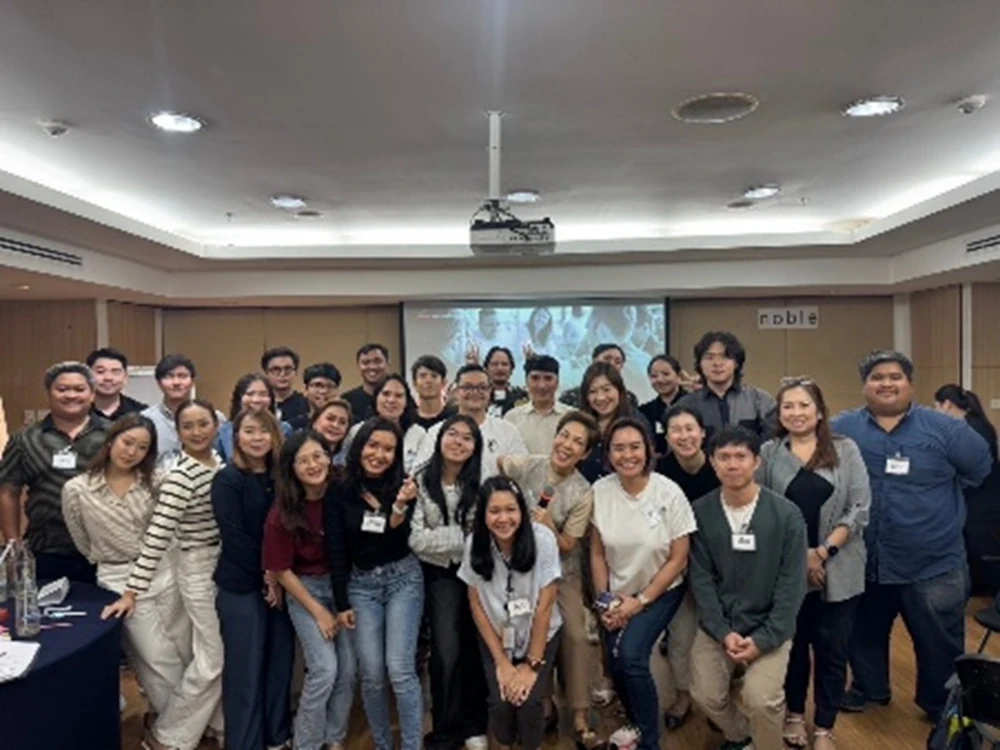
Employee Development and Career Advancement



Goal and Performance Highlights
Goal


Performance 2025



Commitment, Challenge and Opportunity
The Company is committed to developing employee potential and career advancement by defining four core competencies. These include Core Competency (Be Noble) to reinforce shared corporate values, Leadership Competency (Outstanding Team Leader) to nurture leaders who drive team effectiveness, People Management Competency to enhance work efficiency, and Functional Competency to continuously improve the quality of work.
Nevertheless, employee competency development faces challenges from rapid technological change, increasing market expectations, and the retention of talented employees, as well as the need for effective resource allocation and the cultivation of a continuous learning culture at all levels of the organization.
At the same time, this approach presents opportunities to strengthen employee expertise and loyalty, enabling the Company to drive innovation, enhance competitiveness, and better respond to customer needs. These efforts also contribute to the achievement of the United Nations Sustainable Development Goals (SDGs), particularly SDG 8: Decent Work and Economic Growth.
Management and Operational Approach
The Company has established a framework for employee management and capability development by categorizing essential competencies into four types:
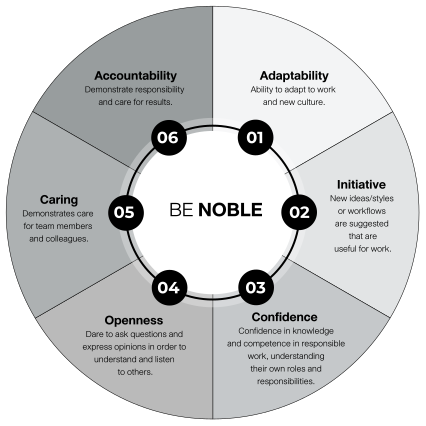
- Core Competency - “Be noble” are the skills and behaviors the Company expects all employees to embody, promoting the “be different, be noble” philosophy. The Company believes that individual differences strengthen the team, driving collective growth and elevating overall success.
- Leadership Competency -“Outstanding Team Leader” refers to the skills, behaviors, and characteristics that the Company expects from its leaders, enabling them to create a positive work environment, lead their teams in the right direction, and foster team development and advancement.
- People Management Competency involves the ability to manage teams effectively by setting work directions, assigning tasks, monitoring and evaluating performance, providing guidance, and resolving work-related issues to ensure team efficiency.
- Functional Competency includes specific knowledge, skills, and behaviors required for employees to perform their job functions effectively.
The Company integrates these four types of competencies into its personnel management processes, covering employee recruitment and selection, performance evaluation, employee development, and career progression planning.
Be NOBLE
Developing Organizational Leadership Capability - Outstanding
- Change: Lead the team through change effectively.
- Challenge: Inspire the team to embrace challenges in their work.
- Decision Making: Make decisions efficiently and effectively.
- Communication: Communicate clearly and effectively.
- Trust: Build and maintain trust within the team.
- Empowerment: Delegate authority and empower the team to make decisions and take action.
Employee Recruitment and Selection
Recruitment and selection are critical processes in building the Company’s long-term sustainability. The Company emphasizes fair, equitable, and non-discriminatory hiring practices. Candidates with the appropriate knowledge and experience for the role are recruited through various channels to promote diversity. The selection process incorporates the assessment of the Core Competency, known as “Be noble,” as a key criterion to evaluate candidates’ ability to integrate into the team and align with the Company’s culture. This is combined with evaluations of knowledge, skills, and work experience to support the Company’s long-term success.
Employee Performance Evaluation
The Company focuses on managing the performance of employees in accordance with the entire system, from the organization, work fields, work groups, departments, and departments to individual employees. The Company has provided performance evaluation standards to ensure adherence to the same guideline throughout the organization through the distribution of the organization’s strategies and goals down to the employees to make them understand the value of the work under their responsibility which directly affects the organization’s success. The Company has set three indicators for employee performance evaluation as follows: performance success, work capabilities, and attitude.
In addition, the Company recognizes the importance of using assessment results as information for employee development. The Company provides opportunities for coaching and feedback. Performance is to be evaluated twice per year as follows:
- Mid-year (June) evaluation: This includes a discussion to inquire about the progress of the work, to improve work plans in response to changing situations, and to assess functional competency in order to create individual development plans (IDP).
- Year-end (December) evaluation: This includes a discussion and an evaluation of the performance for the entire year to summarize the success of the entire year’s work, to praise good performances, to clarify what needs to be improved, and to summarize the evaluation grades in order to manage and improve employees further.
The evaluation results are graded for use in other human resource management matters in the Company, such as the following:
- Annual salary adjustment and bonus payment. This is a remuneration management that has standard criteria and is in line with the remuneration policy and guidelines that focus on paying remuneration to employees fairly and competitively. It is not based on an employee’s gender, racial, or religious differences, but on each employee’s performance.
- Career path management and succession planning. This includes an analysis of the results of the competency and attitude evaluation to develop employees to be ready for growth according to their job position.
Employee Empowerment and Development
The Company recognizes that employees are a valuable resource and a key factor directly contributing to the quality and effectiveness of its operations. Therefore, the Company places great importance on enhancing employees’ knowledge, skills, capabilities, and creativity to strengthen their performance and support their professional growth alongside the organization.
In 2025, the Company provided both In-House Training and Public Training programs for employees at all levels, reaching a total of 788 participants and delivering 8,922 training hours. The training programs were designed to enhance employees’ knowledge, competencies, and job-related skills, while preparing them for future career advancement opportunities. The Company promotes employee development through Individual Development Plans (IDPs), which are jointly developed by employees and their supervisors to ensure that development activities align with individual performance objectives, competencies, and career aspirations. In addition, the Company implements an organization-wide Development Model to systematically strengthen employee capabilities across all levels and support sustainable talent development. Details of the employee development programs are presented below.
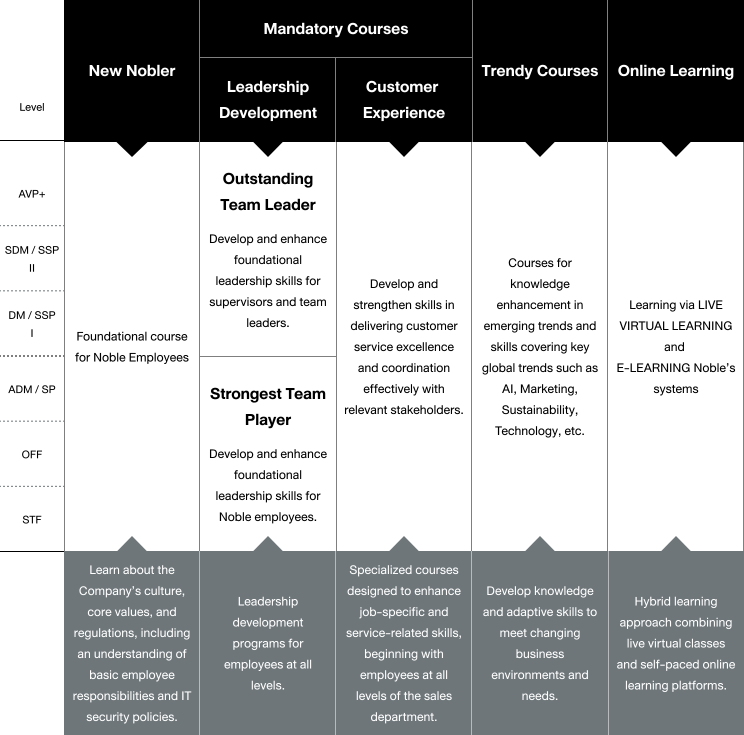
The Company acknowledges the ongoing global changes and, in response, promotes Hybrid Learning to support flexible, on-demand learning that can take place anytime and anywhere beyond the traditional classroom setting. As a result, three distinct learning formats have been developed:
- Classroom Training Focused on in-person learning, this format is designed for courses that require intensive hands-on practice. Course content is tailored and updated annually according to the employee development plan.
- Online Learning Enables employees to develop themselves anytime, anywhere under the principle of “Anywhere, Anytime Learning.” This format is delivered through the Company’s e-learning platform, promoting unrestricted access to learning opportunities.
- Virtual Learning A new learning format through virtual classrooms, allowing employees to engage in real-time learning, participate in group activities, and exchange ideas without location constraints, suitable for today’s borderless world.
Individual Development Plan (IDP)
The Company systematically promotes employee development through Individual Development Plans (IDPs), which are jointly developed by employees and their supervisors. The IDP process is designed to establish development pathways that align with employees’ job responsibilities, capabilities, and career aspirations.
To support employee growth, the Company has established training and development guidelines for each position through its Training Manual and provides a variety of learning opportunities, including internal and external training programs, virtual learning, job assignments, job shadowing, and mentoring. These development approaches enable employees to acquire the knowledge, skills, and practical experience required for both current responsibilities and future career advancement.
In addition, the Company regularly monitors and reviews progress against individual development plans to ensure employees continue to develop competencies that are aligned with both business needs and career progression opportunities. Information obtained through the IDP process is also utilized to support workforce development planning, talent management initiatives, and succession planning for key positions within the organization.
Training and Learning Performance in 2025


Employee Competency Assessment Results 2025
The Company conducts annual competency assessments to evaluate employees’ knowledge, skills, and capabilities required for their roles. The assessment results are used to support Individual Development Plans (IDPs) and long-term talent development initiatives.
100% competency assessment coverage across all defined competencies
Benefits of Employee Development Programs
The Company believes that continuous learning and employee development create value for both employees and the organization. Key benefits of the employee development programs include:
- Career Growth and Development: Employee development programs help enhance employees’ knowledge, skills, and competencies, enabling them to progress in their careers. In 2025, 4% of employees received promotions or job rotations as part of their career development opportunities.
- Enhanced Problem-Solving and Capability Development: Employees are better equipped to solve work-related challenges effectively and may discover new strengths and capabilities that contribute to their professional growth.
- Improved Performance and Employee Value Creation: Development opportunities help employees recognize the value and purpose of their work, strengthen their competencies, and improve their overall work performance and effectiveness.
- Alignment with Organizational Strategy: Employee development initiatives are designed to strengthen capabilities that support the Company’s strategic direction and long-term business objectives.
In addition, the Company evaluates the effectiveness of its human capital development initiatives through the Human Capital Return on Investment (HCROI), which measures the value generated relative to personnel-related investments. In 2025, the Company recorded an HCROI of 1.65 times, reflecting the effectiveness of its investments in employee development and workforce productivity.
Benefits to the Company from Employee Development
The Company believes that continuous employee development is a key driver of organizational competitiveness and sustainable growth. The benefits derived from employee development include:
- Enhanced Business Competitiveness: Developing employees’ knowledge, skills, and capabilities enables the Company to adapt to changing business environments, foster innovation, and strengthen its competitive advantage.
- Improved Employee Retention: Investment in employee development helps enhance engagement and motivation, encouraging employees to grow together with the organization. In 2025, the Company’s employee turnover rate was 10.9%.
- Increased Operational Efficiency and Effectiveness: Employees can apply newly acquired knowledge and skills to improve work quality, enhance productivity, and support the achievement of business objectives.
- Higher Organizational Standards: A structured approach to employee development promotes professionalism, strengthens work standards, and supports continuous improvement across the organization.
- Stronger Organizational Culture and Collaboration: Learning and development initiatives foster a positive work environment, encourage teamwork, facilitate knowledge sharing, and strengthen collaboration across functions.
- A Culture of Continuous Learning and Sustainable Growth: Continuous learning initiatives help cultivate a learning-oriented culture, support employee growth, and establish a strong foundation for the Company’s long-term success and sustainability.
Stakeholders Directly Impacted

Executives & Employees

Customers

Community & Society

Government Agencies

Investors & Shareholders

Suppliers & Contractors

Creditors