
Value Chain Management

The Company realizes the responsibility to all groups of stakeholders in all the operational process. Therefore, the value chain management and development have been implemented as the strategy in business operation to enhance efficiency and create sustainability while taking care of the society and environment. The processes are as follows:
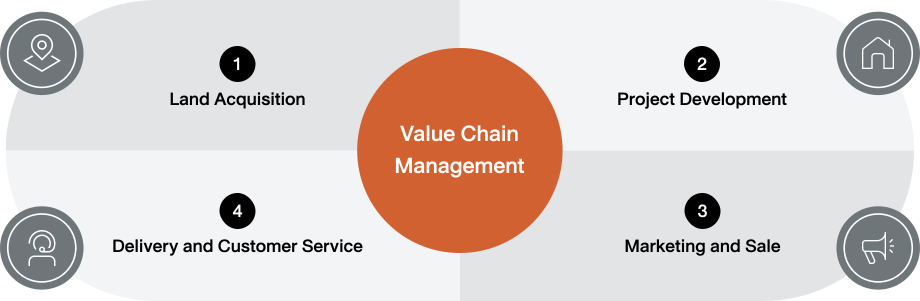
Land Acquisition

Process Value Creation Stakeholders
  • Select the location/find the land and study the feasibility of the project.
  • Establishing a vision for project development in high-potential locations to meet customer needs through thorough research and feasibility analysis. Emphasizing the importance of responsible project development that aligns with social and environmental sustainability, with a firm commitment to ensuring that no new company projects are in the nature conservation areas.
  • Landlord
  • Property Agent
  • Financial Institutions
  • Management and Employees

Project Development

Process Value Creation Stakeholders
  • Project design.
  • Committed to developing sustainable residential project designs that enhance the quality of life for residents, with a focus on environmental responsibility by selecting energy-efficient and eco-friendly materials.
  • Designers
  • Construction Managers
  • Contractor
  • Business Partners
  • Customers
  • Local Communities
  • Government Agencies
  • Management and Employees
  • Application for construction permit.
  • Requesting permission to carry out various operations with the relevant authorities, ensuring compliance with applicable laws, regulations, requirements, and guidelines.
  • Selection of the contractors.
  • Selection of materials and equipment.
  • Establishing a policy for selecting new and existing business partners, outlining a fair, transparent, and accountable process for selecting contractors and materials. The policy emphasizes the importance of choosing contractors and partners who operate with social and environmental responsibility.
  • Designing prefabricated systems to reduce construction time.
  • Setting targets for the use of environmentally friendly materials in the annual materials bidding process.
  • Creating a “Supplier Code of Conduct” to guide business partners in operating with care and responsibility. The Company recognizes that fostering cooperation within the business chain can generate broad positive impacts and drive the Company’s sustainability mission, alongside benefits for society and the environment.
  • Implementing a Vendor Sustainability Assessment Survey (VAS) to evaluate the sustainability of partners, along with assessing risks associated with business partners.
  • Management of surrounding communities.
  • Environmental management during construction.
  • Managing contractors and those involved in the construction process to ensure activities are carried out in accordance with standards, minimizing social and environmental impacts, such as reducing effects on air, water, noise, and the environment. This also includes prioritizing the health and safety of neighboring communities that may be affected by the construction.
  • Implementing communication processes and information channels to foster understanding with the surrounding community in the event of any impacts arising from the construction.

Marketing and Sale

Process Value Creation Stakeholders
  • Advertising and communication.
  • Adhering to the principles of good corporate governance in fair competition, including responsibility towards stakeholders by providing accurate and sufficient information. Respecting customer rights, fulfilling commitments made to customers, and prioritizing the protection and lawful handling of customers’ personal data.
  • Utilizing advertising media that is appropriate for the surrounding environment or nearby areas, ensuring that it does not pose any danger or cause negative environmental impacts.
  • Customers
  • Competitors
  • Marketing Media
  • Management and Employees
  • Communication and distribution Channels.
  • Committed to enhancing communication and distribution channels to facilitate customer access to accurate and comprehensive information, as well as to streamline payment processes for reservations, contract agreements, and installments.
  • Developing and implementing an online project reservation system, including online payment for reservations, contract agreements, and installments, as well as issuing electronic receipts (e-Receipts) to enhance customer convenience and efficiency.
  • Building relationships with customers.
  • Focusing on customer satisfaction by offering a variety of activities to foster strong relationships with customers and providing channels for feedback to enhance and improve services.

Delivery and Customer Service

Process Value Creation Stakeholders
  • Deliver the residence that enhances the quality of life.
  • Conducting quality inspections of condominium units/houses before handover using a defect recording system to ensure efficiency and convenience for customers.
  • Delivering high-quality, standard compliant residences with attention to detail in every handover process. Enhancing after-sales services through Noble Care, which provides consultation on repairs and maintenance to preserve a well-maintained environment and ensure residents’ peace of mind.
  • Developing the CRM Platform “Noble ID” to offer comprehensive, long-term care and services for residents.
  • Providing property management services for projects, including resale and rental management, as well as furniture procurement services for residents.
  • Customer
  • Employees
  • Juristic Persons
  • Competitors